Fermi-Jagla model: Difference between revisions
Jump to navigation
Jump to search
No edit summary |
Carl McBride (talk | contribs) m (Slight tidy + added an internal link) |
||
| Line 5: | Line 5: | ||
There is a relation between Fermi function and hyperbolic tangent: | There is a relation between Fermi function and hyperbolic tangent: | ||
:<math>\frac{1}{ | :<math>\frac{1}{e^x+1}=\frac{1}{2}-\frac{1}{2}\tanh \frac{x}{2}</math> | ||
Using this relation one can connect the Fermi-Jagla model with the [[Fomin potential]]. | |||
==References== | ==References== | ||
<references/> | <references/> | ||
Revision as of 13:41, 23 January 2014
The Fermi-Jagla model is a smooth variant of the Jagla model. It is given by (Eq. 1 in [1]):
![{\displaystyle \Phi _{12}(r)=\epsilon _{0}\left[\left({\frac {a}{r}}\right)^{n}+{\frac {A_{0}}{1+\exp \left[{\frac {A_{1}}{A_{0}}}{\frac {r}{a-A_{2}}}\right]}}-{\frac {B_{0}}{1+\exp \left[{\frac {B_{1}}{B_{0}}}{\frac {r}{a-B_{2}}}\right]}}\right]}](https://wikimedia.org/api/rest_v1/media/math/render/svg/e44449caa9a8f37cb2ead06142358c54adcf6a79)
There is a relation between Fermi function and hyperbolic tangent:
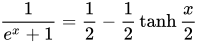
Using this relation one can connect the Fermi-Jagla model with the Fomin potential.
References
- Related reading