Chemical potential: Difference between revisions
Jump to navigation
Jump to search
(See the discussion page) |
No edit summary |
||
| Line 6: | Line 6: | ||
where <math>G</math> is the [[Gibbs energy function]], leading to | where <math>G</math> is the [[Gibbs energy function]], leading to | ||
:<math>\mu=\frac{A}{ | :<math>\frac{\mu}{k_B T}=\frac{G}{N k_B T}=\frac{A}{N k_B T}+\frac{p V}{N k_B T}</math> | ||
where <math>A</math> is the [[Helmholtz energy function]], <math>k_B</math> | where <math>A</math> is the [[Helmholtz energy function]], <math>k_B</math> | ||
Revision as of 17:39, 18 August 2014
Classical thermodynamics
Definition:
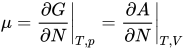
where is the Gibbs energy function, leading to


where is the Helmholtz energy function, is the Boltzmann constant, is the pressure, is the temperature and is the volume.


Statistical mechanics
The chemical potential is the derivative of the Helmholtz energy function with respect to the number of particles
![{\displaystyle \mu =\left.{\frac {\partial A}{\partial N}}\right\vert _{T,V}={\frac {\partial (-k_{B}T\ln Z_{N})}{\partial N}}=-k_{B}T\left[{\frac {3}{2}}\ln \left({\frac {2\pi mk_{B}T}{h^{2}}}\right)+{\frac {\partial \ln Q_{N}}{\partial N}}\right]}](https://wikimedia.org/api/rest_v1/media/math/render/svg/f7ba41c2ea2239a55a40d9fd20ab381affe95d4d)
where is the partition function for a fluid of identical particles


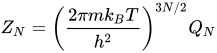
and is the configurational integral


Kirkwood charging formula
The Kirkwood charging formula is given by [1]

where is the intermolecular pair potential and is the pair correlation function.


See also
References
Related reading
- G. Cook and R. H. Dickerson "Understanding the chemical potential", American Journal of Physics 63 pp. 737-742 (1995)
- T. A. Kaplan "The Chemical Potential", Journal of Statistical Physics 122 pp. 1237-1260 (2006)
- Federico G. Pazzona, Pierfranco Demontis, and Giuseppe B. Suffritti "Chemical potential evaluation in NVT lattice-gas simulations", Journal of Chemical Physics 137 154106 (2012)