Gibbs ensemble: Difference between revisions
No edit summary |
Carl McBride (talk | contribs) |
||
| (6 intermediate revisions by 2 users not shown) | |||
| Line 1: | Line 1: | ||
Here we have the ''N-particle distribution function'' | |||
(Ref. 1 Eq. 2.2) | |||
:<math>\mathcal{G}_{(N)} ({\mathbf X}_{(N)},t)= \frac{\Gamma_{(N)}^{(0)}}{\mathcal{N}} \frac{{\rm d}\mathcal{N}}{{\rm d}\Gamma_{(N)}}</math> | |||
where <math>\Gamma_{(N)}^{(0)}</math> is a normalized constant with the dimensions | |||
of the [[phase space]] <math>\left. \Gamma_{(N)} \right.</math>. | |||
:<math>{\mathbf X}_{(N)} = \{ {\mathbf r}_1 , ..., {\mathbf r}_N ; {\mathbf p}_1 , ..., {\mathbf p}_N \}</math> | |||
Normalization condition (Ref. 1 Eq. 2.3): | |||
:<math>\frac{1}{\Gamma_{(N)}^{(0)}} \int_{\Gamma_{(N)}} \mathcal{G}_{(N)} {\rm d}\mathcal{N} =1</math> | |||
it is convenient to set (Ref. 1 Eq. 2.4) | |||
:<math>\Gamma_{(N)}^{(0)} = V^N \mathcal{P}^{3N}</math> | |||
where <math>V</math> is the volume of the system and <math>\mathcal{P}</math> is the characteristic momentum | |||
of the particles (Ref. 1 Eq. 3.26), | |||
:<math>\mathcal{P} = \sqrt{2 \pi m \Theta}</math> | |||
Macroscopic mean values are given by (Ref. 1 Eq. 2.5) | |||
:<math>\langle \psi ({\mathbf r},t)\rangle= \frac{1}{\Gamma_{(N)}^{(0)}} | |||
\int_{\Gamma_{(N)}} \psi ({\mathbf X}_{(N)}) \mathcal{G}_{(N)} ({\mathbf X}_{(N)},t) {\rm d}\Gamma_{(N)} | |||
</math> | |||
===[[Ergodic hypothesis |Ergodic theory]]=== | |||
Ref. 1 Eq. 2.6 | |||
:<math>\langle \psi \rangle = \overline \psi</math> | |||
===[[Entropy]]=== | |||
Ref. 1 Eq. 2.70 | |||
:<math>S_{(N)}= - \frac{k_B}{ V^N \mathcal{P}^{3N}} \int_\Gamma \Omega_1,... _N \mathcal{G}_1,... _N {\rm d}\Gamma_{(N)}</math> | |||
where <math>\Omega</math> is the ''N''-particle [[thermal potential]] (Ref. 1 Eq. 2.12) | |||
:<math>\Omega_{(N)} ({\mathbf X}_{(N)},t)= \ln \mathcal{G}_{(N)} ({\mathbf X}_{(N)},t)</math> | |||
==References== | |||
# G. A. Martynov "Fundamental Theory of Liquids. Method of Distribution Functions", Adam Hilger (out of print) | |||
[[category: statistical mechanics]] | |||
Latest revision as of 16:45, 21 November 2007
Here we have the N-particle distribution function (Ref. 1 Eq. 2.2)
- Failed to parse (SVG (MathML can be enabled via browser plugin): Invalid response ("Math extension cannot connect to Restbase.") from server "https://wikimedia.org/api/rest_v1/":): {\displaystyle \mathcal{G}_{(N)} ({\mathbf X}_{(N)},t)= \frac{\Gamma_{(N)}^{(0)}}{\mathcal{N}} \frac{{\rm d}\mathcal{N}}{{\rm d}\Gamma_{(N)}}}
where Failed to parse (SVG (MathML can be enabled via browser plugin): Invalid response ("Math extension cannot connect to Restbase.") from server "https://wikimedia.org/api/rest_v1/":): {\displaystyle \Gamma_{(N)}^{(0)}} is a normalized constant with the dimensions of the phase space Failed to parse (SVG (MathML can be enabled via browser plugin): Invalid response ("Math extension cannot connect to Restbase.") from server "https://wikimedia.org/api/rest_v1/":): {\displaystyle \left. \Gamma_{(N)} \right.} .
- Failed to parse (SVG (MathML can be enabled via browser plugin): Invalid response ("Math extension cannot connect to Restbase.") from server "https://wikimedia.org/api/rest_v1/":): {\displaystyle {\mathbf X}_{(N)} = \{ {\mathbf r}_1 , ..., {\mathbf r}_N ; {\mathbf p}_1 , ..., {\mathbf p}_N \}}
Normalization condition (Ref. 1 Eq. 2.3):
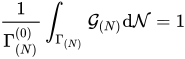
it is convenient to set (Ref. 1 Eq. 2.4)
- Failed to parse (SVG (MathML can be enabled via browser plugin): Invalid response ("Math extension cannot connect to Restbase.") from server "https://wikimedia.org/api/rest_v1/":): {\displaystyle \Gamma_{(N)}^{(0)} = V^N \mathcal{P}^{3N}}
where Failed to parse (SVG (MathML can be enabled via browser plugin): Invalid response ("Math extension cannot connect to Restbase.") from server "https://wikimedia.org/api/rest_v1/":): {\displaystyle V} is the volume of the system and Failed to parse (SVG (MathML can be enabled via browser plugin): Invalid response ("Math extension cannot connect to Restbase.") from server "https://wikimedia.org/api/rest_v1/":): {\displaystyle \mathcal{P}} is the characteristic momentum of the particles (Ref. 1 Eq. 3.26),
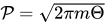
Macroscopic mean values are given by (Ref. 1 Eq. 2.5)
- Failed to parse (SVG (MathML can be enabled via browser plugin): Invalid response ("Math extension cannot connect to Restbase.") from server "https://wikimedia.org/api/rest_v1/":): {\displaystyle \langle \psi ({\mathbf r},t)\rangle= \frac{1}{\Gamma_{(N)}^{(0)}} \int_{\Gamma_{(N)}} \psi ({\mathbf X}_{(N)}) \mathcal{G}_{(N)} ({\mathbf X}_{(N)},t) {\rm d}\Gamma_{(N)} }
Ergodic theory[edit]
Ref. 1 Eq. 2.6
- Failed to parse (SVG (MathML can be enabled via browser plugin): Invalid response ("Math extension cannot connect to Restbase.") from server "https://wikimedia.org/api/rest_v1/":): {\displaystyle \langle \psi \rangle = \overline \psi}
Entropy[edit]
Ref. 1 Eq. 2.70
- Failed to parse (SVG (MathML can be enabled via browser plugin): Invalid response ("Math extension cannot connect to Restbase.") from server "https://wikimedia.org/api/rest_v1/":): {\displaystyle S_{(N)}= - \frac{k_B}{ V^N \mathcal{P}^{3N}} \int_\Gamma \Omega_1,... _N \mathcal{G}_1,... _N {\rm d}\Gamma_{(N)}}
where is the N-particle thermal potential (Ref. 1 Eq. 2.12)

- Failed to parse (SVG (MathML can be enabled via browser plugin): Invalid response ("Math extension cannot connect to Restbase.") from server "https://wikimedia.org/api/rest_v1/":): {\displaystyle \Omega_{(N)} ({\mathbf X}_{(N)},t)= \ln \mathcal{G}_{(N)} ({\mathbf X}_{(N)},t)}
References[edit]
- G. A. Martynov "Fundamental Theory of Liquids. Method of Distribution Functions", Adam Hilger (out of print)