Ising model

From SklogWiki
Revision as of 11:20, 23 February 2007 by Noe (talk | contribs)
Jump to navigation Jump to search

Ising Model

The Ising model is commonly defined over an ordered lattice. Each site of the lattice can adopt two states: either UP (S=+1) or DOWN (S=-1).

The energy of the system is the sum of pair interactions between nearest neighbors.
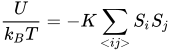
Failed to parse (SVG (MathML can be enabled via browser plugin): Invalid response ("Math extension cannot connect to Restbase.") from server "https://wikimedia.org/api/rest_v1/":): {\displaystyle \frac{U}{k_B T} = - K \sum_{<ij>} S_i S_j }

where Failed to parse (SVG (MathML can be enabled via browser plugin): Invalid response ("Math extension cannot connect to Restbase.") from server "https://wikimedia.org/api/rest_v1/":): {\displaystyle <ij> } indicates that the sum is done over nearest neighbors, and Failed to parse (SVG (MathML can be enabled via browser plugin): Invalid response ("Math extension cannot connect to Restbase.") from server "https://wikimedia.org/api/rest_v1/":): {\displaystyle S_i } indicates the state of the i-th site.

Failed to parse (SVG (MathML can be enabled via browser plugin): Invalid response ("Math extension cannot connect to Restbase.") from server "https://wikimedia.org/api/rest_v1/":): {\displaystyle K } is called the Coupling constant.

to be continued:

Ising Model (1d)

Other topics

  • Usual lattices in 2d: Critical behavior
  • Lattices in 3-d
  • Ferromagnetic and antiferromagnetic couplings
  • Frustration, etc
  • Simulation procedures
  • Theoretical methods