Surface tension
The surface tension, , is a measure of the work required to create a surface.

Thermodynamics
In the Canonical ensemble the surface tension is formally given as:
- ;
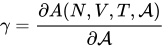
where
- is the Helmholtz energy function
- is the number of particles
- is the volume
- is the temperature
- is the surface area


Computer Simulation
A review of the different techniques that can be used to compute the surface (interface) tension can be found in the paper by Gloor et al. (Ref. 1).
Liquid-Vapour Interfaces of one component systems
Binder procedure
Here, only an outline of the procedure is presented, more details can be found in Reference 2. For given conditions of volume and temperature, the Helmholtz energy function is computed as a function of the number of molecules, . The calculation is usually carried out using Monte Carlo simulation using periodic boundary conditions If liquid-vapour equilibrium occurs, a plot of the chemical potential, , as a function of Failed to parse (SVG (MathML can be enabled via browser plugin): Invalid response ("Math extension cannot connect to Restbase.") from server "https://wikimedia.org/api/rest_v1/":): {\displaystyle N } shows a loop. Using basic thermodynamic procedures (Maxwell's equal area construction) it is possible to compute the densities of the two phases; Failed to parse (SVG (MathML can be enabled via browser plugin): Invalid response ("Math extension cannot connect to Restbase.") from server "https://wikimedia.org/api/rest_v1/":): {\displaystyle \rho_v, \rho_l } at liquid-vapour equilibrium. Considering the thermodynamic limit for densities Failed to parse (SVG (MathML can be enabled via browser plugin): Invalid response ("Math extension cannot connect to Restbase.") from server "https://wikimedia.org/api/rest_v1/":): {\displaystyle \rho } with Failed to parse (SVG (MathML can be enabled via browser plugin): Invalid response ("Math extension cannot connect to Restbase.") from server "https://wikimedia.org/api/rest_v1/":): {\displaystyle \rho_v < \rho < \rho_l } the Helmholtz energy function will be:


- Failed to parse (SVG (MathML can be enabled via browser plugin): Invalid response ("Math extension cannot connect to Restbase.") from server "https://wikimedia.org/api/rest_v1/":): {\displaystyle A(N) = - p_{eq} V + \mu_{eq} N + \gamma {\mathcal A}(N) }
where the quantities with the subindex "eq" are those corresponding to the fluid-phase equilibrium situation. From the previous equation one can write
- Failed to parse (SVG (MathML can be enabled via browser plugin): Invalid response ("Math extension cannot connect to Restbase.") from server "https://wikimedia.org/api/rest_v1/":): {\displaystyle \Omega (N) \equiv A(N) - \mu_{eq} N = - p_{eq} V + \gamma {\mathcal A}(N) } .
For appropriate values of Failed to parse (SVG (MathML can be enabled via browser plugin): Invalid response ("Math extension cannot connect to Restbase.") from server "https://wikimedia.org/api/rest_v1/":): {\displaystyle N } one can estimate the value of the surface area, Failed to parse (SVG (MathML can be enabled via browser plugin): Invalid response ("Math extension cannot connect to Restbase.") from server "https://wikimedia.org/api/rest_v1/":): {\displaystyle {\mathcal A} } (See MacDowell, Ref. 3), and compute Failed to parse (SVG (MathML can be enabled via browser plugin): Invalid response ("Math extension cannot connect to Restbase.") from server "https://wikimedia.org/api/rest_v1/":): {\displaystyle \gamma } directly as:
- Failed to parse (SVG (MathML can be enabled via browser plugin): Invalid response ("Math extension cannot connect to Restbase.") from server "https://wikimedia.org/api/rest_v1/":): {\displaystyle \gamma = \frac{ \Omega(N) + p_{eq} V } { {\mathcal A}(N) } = \frac{ \Omega(N) - \frac{1}{2}(\Omega(N_l)+\Omega(N_v)) }{{\mathcal A}(N)} }
where Failed to parse (SVG (MathML can be enabled via browser plugin): Invalid response ("Math extension cannot connect to Restbase.") from server "https://wikimedia.org/api/rest_v1/":): {\displaystyle N_l } and Failed to parse (SVG (MathML can be enabled via browser plugin): Invalid response ("Math extension cannot connect to Restbase.") from server "https://wikimedia.org/api/rest_v1/":): {\displaystyle N_v } are given by: Failed to parse (SVG (MathML can be enabled via browser plugin): Invalid response ("Math extension cannot connect to Restbase.") from server "https://wikimedia.org/api/rest_v1/":): {\displaystyle N_l = V \cdot \rho_l } and Failed to parse (SVG (MathML can be enabled via browser plugin): Invalid response ("Math extension cannot connect to Restbase.") from server "https://wikimedia.org/api/rest_v1/":): {\displaystyle N_v = V \cdot \rho_v }
Explicit interfaces
In these methods one performs a direct simulation of the two-phase system. Periodic boundary conditions are usually employed. Simulation boxes are elongated in one direction, and the interfaces are built (and expected to stay) perpendicular to such a direction.
Mixtures
References
- Guy J. Gloor, George Jackson, Felipe J. Blas and Enrique de Miguel "Test-area simulation method for the direct determination of the interfacial tension of systems with continuous or discontinuous potentials", Journal of Chemical Physics 123 134703 (2005)
- K. Binder "Monte Carlo calculation of the surface tension for two- and three-dimensional lattice-gas models", Physical Review A 25 pp. 1699 - 1709 (1982)
- L. G. MacDowell, V. K. Shen, and J. R. Errington "Nucleation and cavitation of spherical, cylindrical, and slablike droplets and bubbles in small systems", Journal of Chemical Physics 125 034705 (2006)