Rose-Vinet (Universal) equation of state
Vinet
In order to rectify the excessive stiffness of the Murnaghan equation of state as well as represent the exponential dependence of the repulsion as solid undergoes strong compression, Vinet proposed an equation of state (without mentioning that it had been used for instance by F. D. Stacey, B. J. Brennan and R. D. Irvine in "Finite strain theores and comparison with seismological data", Geophysical Surveys, 4, 189-232 (1989)previously as either the Vinet equation of state or Universal equation of state[1]. The equation of state was formulated so that one form could represent all solids in reasonably wide rqanches of pressure, depending only on data for the calibration point. Using the shorthand for the cube root specific volume:
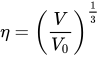
the equation of state is (Eq. 4.1):
