Buckingham potential

|
This article is a 'stub' page, it has no, or next to no, content. It is here at the moment to help form part of the structure of SklogWiki. If you add sufficient material to this article then please remove the {{Stub-general}} template from this page. |
The Buckingham potential is given by [1]
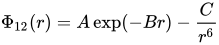
where Failed to parse (SVG (MathML can be enabled via browser plugin): Invalid response ("Math extension cannot connect to Restbase.") from server "https://wikimedia.org/api/rest_v1/":): {\displaystyle \Phi_{12}(r)} is the intermolecular pair potential, Failed to parse (SVG (MathML can be enabled via browser plugin): Invalid response ("Math extension cannot connect to Restbase.") from server "https://wikimedia.org/api/rest_v1/":): {\displaystyle r := |\mathbf{r}_1 - \mathbf{r}_2|} , and Failed to parse (SVG (MathML can be enabled via browser plugin): Invalid response ("Math extension cannot connect to Restbase.") from server "https://wikimedia.org/api/rest_v1/":): {\displaystyle A} , Failed to parse (SVG (MathML can be enabled via browser plugin): Invalid response ("Math extension cannot connect to Restbase.") from server "https://wikimedia.org/api/rest_v1/":): {\displaystyle B} and are constants.

The Buckingham potential describes the exchange repulsion, which originates from the Pauli exclusion principle, by a more realistic exponential function of distance, in contrast to the inverse twelfth power used by the Lennard-Jones potential. However, since the Buckingham potential remains finite even at very small distances, it runs the risk of an un-physical "Buckingham catastrophe" at short range when used in simulations of charged systems.This occurs when the electrostatic attraction artificially overcomes the repulsive barrier. The Lennard-Jones potential is also quicker to compute, and so is more frequently used in computer simulations.