1-dimensional hard rods
Hard Rods, 1-dimensional system with hard sphere interactions.
The statistical mechanics of this system can be solved exactly (see Ref. 1).
Canonical Ensemble: Configuration Integral
Consider a system of length defined in the range .

![{\displaystyle \left[0,L\right]}](https://wikimedia.org/api/rest_v1/media/math/render/svg/f4d989db4732ced308e9b4e495dfbaf0dd2bd5d6)
Our aim is to compute the partition function of a system of hard rods of length .


Model:
- External Potential; the whole length of the rod must be inside the range:

- Pair Potential:

where Failed to parse (SVG (MathML can be enabled via browser plugin): Invalid response ("Math extension cannot connect to Restbase.") from server "https://wikimedia.org/api/rest_v1/":): {\displaystyle \left. x_k \right. } is the position of the center of the k-th rod.
Consider that the particles are ordered according to their label: Failed to parse (SVG (MathML can be enabled via browser plugin): Invalid response ("Math extension cannot connect to Restbase.") from server "https://wikimedia.org/api/rest_v1/":): {\displaystyle x_0 < x_1 < x_2 < \cdots < x_{N-1} } ;
taking into account the pair potential we can write the canonical parttion function (configuration integral) of a system of Failed to parse (SVG (MathML can be enabled via browser plugin): Invalid response ("Math extension cannot connect to Restbase.") from server "https://wikimedia.org/api/rest_v1/":): {\displaystyle N } particles as:
- Failed to parse (SVG (MathML can be enabled via browser plugin): Invalid response ("Math extension cannot connect to Restbase.") from server "https://wikimedia.org/api/rest_v1/":): {\displaystyle \frac{ Z \left( N,L \right)}{N!} = \int_{\sigma/2}^{L+\sigma/2-N\sigma} d x_0 \int_{x_0+\sigma}^{L+\sigma/2-N\sigma+\sigma} d x_1 \cdots \int_{x_{i-1}+\sigma}^{L+\sigma/2-N\sigma+i \sigma} d x_i \cdots \int_{x_{N-2}+\sigma}^{L+\sigma/2-N\sigma+(N-1)\sigma} d x_{N-1}. }
Variable change: ; we get:
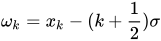
- Failed to parse (SVG (MathML can be enabled via browser plugin): Invalid response ("Math extension cannot connect to Restbase.") from server "https://wikimedia.org/api/rest_v1/":): {\displaystyle \frac{ Z \left( N,L \right)}{N!} = \int_{0}^{L-N\sigma} d \omega_0 \int_{\omega_0}^{L-N\sigma} d \omega_1 \cdots \int_{\omega_{i-1}}^{L-N\sigma} d \omega_i \cdots \int_{\omega_{N-2}}^{L-N\sigma} d \omega_{N-1}. }
Therefore: Failed to parse (SVG (MathML can be enabled via browser plugin): Invalid response ("Math extension cannot connect to Restbase.") from server "https://wikimedia.org/api/rest_v1/":): {\displaystyle \frac{ Z \left( N,L \right)}{N!} = \frac{ (V-N)^{N} }{N!}. }
- Failed to parse (SVG (MathML can be enabled via browser plugin): Invalid response ("Math extension cannot connect to Restbase.") from server "https://wikimedia.org/api/rest_v1/":): {\displaystyle Q(N,L) = \frac{ (V-N)^N}{\Lambda^N N!}. }