Fomin potential
The Fomin potential was firstly introduced as [1] (Eq. 2):

where is the intermolecular pair potential, is the distance between site 1 and site 2, and . is the diameter of the hard core, is the width of the repulsive shoulder, is the height of the shoulder. As such, this model can be viewed as a softened square shoulder model.

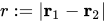


Later it was generalized to the form [2] :

By varying coefficients one can add repulsive shoulders or attractive wells to the potential.

References
- ↑ Yu. D. Fomin, N. V. Gribova, V. N. Ryzhov, S. M. Stishov, and Daan Frenkel "Quasibinary amorphous phase in a three-dimensional system of particles with repulsive-shoulder interactions", Journal of Chemical Physics 129 064512 (2008)
- ↑ Yu. D. Fomin, E. N. Tsiok and V. N. Ryzhov, "Complex phase behavior of the system of particles with smooth potential with repulsive shoulder and attractive well", Journal of Chemical Physics 134 044523 (2011)