Surface tension: Difference between revisions
| Line 13: | Line 13: | ||
*<math>A</math> is the [[Helmholtz energy function]] | *<math>A</math> is the [[Helmholtz energy function]] | ||
==Computer Simulation== | ==Computer Simulation== | ||
A review on different techniques to compute surface (interface) tension can be found in the paper by Gloor et al. | |||
==Liquid-Vapour Interfaces of one component systems == | ==Liquid-Vapour Interfaces of one component systems == | ||
Revision as of 11:00, 1 August 2007
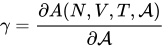
The surface tension, Failed to parse (SVG (MathML can be enabled via browser plugin): Invalid response ("Math extension cannot connect to Restbase.") from server "https://wikimedia.org/api/rest_v1/":): {\displaystyle \gamma } , is a measure of the work required to create a surface. In the Canonical ensemble: two phases;
- Failed to parse (SVG (MathML can be enabled via browser plugin): Invalid response ("Math extension cannot connect to Restbase.") from server "https://wikimedia.org/api/rest_v1/":): {\displaystyle \gamma = \frac{ \partial A (N,V,T, {\mathcal A} )}{\partial {\mathcal A} } } ;
where
- Failed to parse (SVG (MathML can be enabled via browser plugin): Invalid response ("Math extension cannot connect to Restbase.") from server "https://wikimedia.org/api/rest_v1/":): {\displaystyle N } is the number of particles
- Failed to parse (SVG (MathML can be enabled via browser plugin): Invalid response ("Math extension cannot connect to Restbase.") from server "https://wikimedia.org/api/rest_v1/":): {\displaystyle V } is the volume
- Failed to parse (SVG (MathML can be enabled via browser plugin): Invalid response ("Math extension cannot connect to Restbase.") from server "https://wikimedia.org/api/rest_v1/":): {\displaystyle T } is the temperature
- Failed to parse (SVG (MathML can be enabled via browser plugin): Invalid response ("Math extension cannot connect to Restbase.") from server "https://wikimedia.org/api/rest_v1/":): {\displaystyle {\mathcal A} } is the surface area
- Failed to parse (SVG (MathML can be enabled via browser plugin): Invalid response ("Math extension cannot connect to Restbase.") from server "https://wikimedia.org/api/rest_v1/":): {\displaystyle A} is the Helmholtz energy function
Computer Simulation
A review on different techniques to compute surface (interface) tension can be found in the paper by Gloor et al.
Liquid-Vapour Interfaces of one component systems
- Binder procedure
For given conditions of volume and temperature, the Helmholtz energy function is computed as a function of the number of molecules:
Failed to parse (SVG (MathML can be enabled via browser plugin): Invalid response ("Math extension cannot connect to Restbase.") from server "https://wikimedia.org/api/rest_v1/":): {\displaystyle A(N;V,T) }
The calculation is usually carried out using Monte Carlo simulation
If liquid-vapour equilibrium occurs, the plot of the chemical potential, Failed to parse (SVG (MathML can be enabled via browser plugin): Invalid response ("Math extension cannot connect to Restbase.") from server "https://wikimedia.org/api/rest_v1/":): {\displaystyle \mu \equiv (\partial A/\partial N)_{V,T} } , as a function of Failed to parse (SVG (MathML can be enabled via browser plugin): Invalid response ("Math extension cannot connect to Restbase.") from server "https://wikimedia.org/api/rest_v1/":): {\displaystyle N } shows a loop.
Using basic thermodynamic procedures (Maxwell construction) it is possible to compute the densities of the two phases; Failed to parse (SVG (MathML can be enabled via browser plugin): Invalid response ("Math extension cannot connect to Restbase.") from server "https://wikimedia.org/api/rest_v1/":): {\displaystyle \rho_v, \rho_l }
- Explicit interface