Canonical ensemble: Difference between revisions
Jump to navigation
Jump to search
mNo edit summary |
|||
| Line 24: | Line 24: | ||
* <math> \left( R^*\right)^{3N} </math> represent the 3N position coordinates of the particles (reduced with the system size): i.e. <math> \int d (R^*)^{3N} = 1 </math> | * <math> \left( R^*\right)^{3N} </math> represent the 3N position coordinates of the particles (reduced with the system size): i.e. <math> \int d (R^*)^{3N} = 1 </math> | ||
== [[Free energy]] == | |||
Revision as of 20:47, 19 February 2007
Canonical Ensemble:
Variables:
- Number of Particles,

- Volume,

- Temperature,

Partition Function
Classical Partition Function (one-component system) in a three-dimensional space:

![{\displaystyle Q_{NVT}={\frac {V^{N}}{N!\Lambda ^{3N}}}\int d(R^{*})^{3N}\exp \left[-\beta U\left(V,(R^{*})^{3N}\right)\right]}](https://wikimedia.org/api/rest_v1/media/math/render/svg/e0a1f8d5945d276d66dfbbee4f95a936b41a5a17)
where:
- is the de Broglie wavelength

- , with being the Boltzmann constant,


- is the potential energy, which depends on the coordinates of the particles (and on the interaction model)

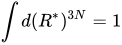
- represent the 3N position coordinates of the particles (reduced with the system size): i.e.