Mean field models: Difference between revisions
(Completed solution, section added.) |
m (Added link to Curie's_law) |
||
| Line 13: | Line 13: | ||
Therefore, the Hamiltonian turns to | Therefore, the Hamiltonian turns to | ||
:<math> U = - J n \sum_i^N S_i \bar{s} , </math> | :<math> U = - J n \sum_i^N S_i \bar{s} , </math> | ||
as in the regular Langevin theory of magnetism: the spins are independent, but coupled to a constant field of strength | as in the regular Langevin theory of magnetism (see [[Curie's_law]]): the spins are independent, but coupled to a constant field of strength | ||
:<math>H= J n \bar{s}.</math> | :<math>H= J n \bar{s}.</math> | ||
The magnetization of the Langevin theory is | The magnetization of the Langevin theory is | ||
Revision as of 16:28, 3 May 2010
A mean field model, or a mean field solution of a model, is an approximation to the actual solution of a model in statistical physics. The model is made exactly solvable by treating the effect of all other particles on a given one as a mean field (hence its name). It appear in different forms and different contexts, but all mean field models have this feature in common.
Mean field solution of the Ising model
A well-known mean field solution of the Ising model, known as the Bragg-Williams approximation goes as follows. From the original Hamiltonian,
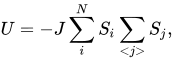
suppose we may approximate
- Failed to parse (SVG (MathML can be enabled via browser plugin): Invalid response ("Math extension cannot connect to Restbase.") from server "https://wikimedia.org/api/rest_v1/":): {\displaystyle \sum_{<j>} S_j \approx n \bar{s}, }
where Failed to parse (SVG (MathML can be enabled via browser plugin): Invalid response ("Math extension cannot connect to Restbase.") from server "https://wikimedia.org/api/rest_v1/":): {\displaystyle n} is the number of neighbors of site Failed to parse (SVG (MathML can be enabled via browser plugin): Invalid response ("Math extension cannot connect to Restbase.") from server "https://wikimedia.org/api/rest_v1/":): {\displaystyle i} (e.g. 4 in a 2-D square lattice), and Failed to parse (SVG (MathML can be enabled via browser plugin): Invalid response ("Math extension cannot connect to Restbase.") from server "https://wikimedia.org/api/rest_v1/":): {\displaystyle \bar{s}} is the (unknown) magnetization:
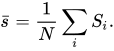
Therefore, the Hamiltonian turns to
- Failed to parse (SVG (MathML can be enabled via browser plugin): Invalid response ("Math extension cannot connect to Restbase.") from server "https://wikimedia.org/api/rest_v1/":): {\displaystyle U = - J n \sum_i^N S_i \bar{s} , }
as in the regular Langevin theory of magnetism (see Curie's_law): the spins are independent, but coupled to a constant field of strength
- Failed to parse (SVG (MathML can be enabled via browser plugin): Invalid response ("Math extension cannot connect to Restbase.") from server "https://wikimedia.org/api/rest_v1/":): {\displaystyle H= J n \bar{s}.}
The magnetization of the Langevin theory is
- Failed to parse (SVG (MathML can be enabled via browser plugin): Invalid response ("Math extension cannot connect to Restbase.") from server "https://wikimedia.org/api/rest_v1/":): {\displaystyle \bar{s} = \tanh( H/k_B T ). }
Therefore:
- Failed to parse (SVG (MathML can be enabled via browser plugin): Invalid response ("Math extension cannot connect to Restbase.") from server "https://wikimedia.org/api/rest_v1/":): {\displaystyle \bar{s} = \tanh(J n\bar{s}/k_B T). }
This is a self-consistent expression for . There exists a critical temperature, defined by

- Failed to parse (SVG (MathML can be enabled via browser plugin): Invalid response ("Math extension cannot connect to Restbase.") from server "https://wikimedia.org/api/rest_v1/":): {\displaystyle k_B T_c= J n .}
At temperatures higher than this value the only solution is Failed to parse (SVG (MathML can be enabled via browser plugin): Invalid response ("Math extension cannot connect to Restbase.") from server "https://wikimedia.org/api/rest_v1/":): {\displaystyle \bar{s}=0} . Below it, however, this solution becomes unstable (it corresponds to a maximum in energy), whereas two others are stable. Slightly below Failed to parse (SVG (MathML can be enabled via browser plugin): Invalid response ("Math extension cannot connect to Restbase.") from server "https://wikimedia.org/api/rest_v1/":): {\displaystyle T_c} ,
- Failed to parse (SVG (MathML can be enabled via browser plugin): Invalid response ("Math extension cannot connect to Restbase.") from server "https://wikimedia.org/api/rest_v1/":): {\displaystyle \bar{s} =\pm\sqrt{3\left(1 - \frac{T}{T_c}\right)}. }
General discussion
The solution obtained shares a number of features with any other mean field approximation:
- It largely ignores geometry, which may be important in some cases. In particular, it reduces the lattice details to just the number of neighbours.
- As a consequence, it may predict phase transitions where none are found: the 1-D ising model is known to lack any phase transition (at finite temperature)
- In general, the theory underestimates fluctuations
- It also leads to classical critical exponents, like the Failed to parse (SVG (MathML can be enabled via browser plugin): Invalid response ("Math extension cannot connect to Restbase.") from server "https://wikimedia.org/api/rest_v1/":): {\displaystyle \left(1 - \frac{T}{T_c}\right)^{1/2}} decay above. In 3-D, the magnetization follows a power law with a different exponent.
- Nevertheless, above a certain space dimension the critical exponents are correct. This dimension is 4 for the Ising model, as predicted by a self-consistency requirement due to E.M. Lipfshitz (similar ones are due to Peierls and L.D. Landau)
