Structure factor: Difference between revisions
Jump to navigation
Jump to search
m (Slight tidy) |
No edit summary |
||
| Line 6: | Line 6: | ||
where <math>k</math> is the scattering wave-vector modulus | where <math>k</math> is the scattering wave-vector modulus | ||
:<math>k= |\mathbf{k}|= \frac{4 \pi }{\lambda \sin \left( \frac{\theta}{2}\right) | :<math>k= |\mathbf{k}|= \frac{4 \pi }{\lambda} \sin \left( \frac{\theta}{2}\right)</math> | ||
The structure factor is basically a [[Fourier analysis | Fourier transform]] of the [[pair distribution function]] <math>{\rm g}(r)</math>, | The structure factor is basically a [[Fourier analysis | Fourier transform]] of the [[pair distribution function]] <math>{\rm g}(r)</math>, | ||
Revision as of 14:33, 16 November 2011
The structure factor, , for a monatomic system is defined by:


where is the scattering wave-vector modulus

- Failed to parse (Conversion error. Server ("https://wikimedia.org/api/rest_") reported: "Cannot get mml. Server problem."): {\displaystyle k=|\mathbf {k} |={\frac {4\pi }{\lambda }}\sin \left({\frac {\theta }{2}}\right)}
The structure factor is basically a Fourier transform of the pair distribution function ,


At zero wavenumber, i.e. ,

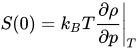
from which one can calculate the isothermal compressibility.
To calculate in molecular simulations one typically uses:
- ,
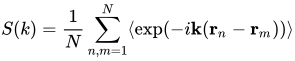
where is the number of particles and and are the coordinates of particles and respectively.


The dynamic, time dependent structure factor is defined as follows:
- Failed to parse (Conversion error. Server ("https://wikimedia.org/api/rest_") reported: "Cannot get mml. Server problem."): {\displaystyle S(k,t)={\frac {1}{N}}\sum _{n,m=1}^{N}\langle \exp(-i\mathbf {k} (\mathbf {r} _{n}(t)-\mathbf {r} _{m}(0)))\rangle } ,
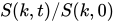
The ratio between the dynamic and the static structure factor, , is known as the collective (or coherent) intermediate scattering function.
References
- Related reading