Kern and Frenkel patchy model: Difference between revisions
Jump to navigation
Jump to search
| Line 30: | Line 30: | ||
The "two-patch" Kern and Frenkel model has been extensively studied by Giacometti et al. <ref>[http://dx.doi.org/10.1063/1.3415490 Achille Giacometti, Fred Lado, Julio Largo, Giorgio Pastore, and Francesco Sciortino "Effects of patch size and number within a simple model of patchy colloids", Journal of Chemical Physics 132, 174110 (2010)]</ref>. | The "two-patch" Kern and Frenkel model has been extensively studied by Giacometti et al. <ref>[http://dx.doi.org/10.1063/1.3415490 Achille Giacometti, Fred Lado, Julio Largo, Giorgio Pastore, and Francesco Sciortino "Effects of patch size and number within a simple model of patchy colloids", Journal of Chemical Physics 132, 174110 (2010)]</ref>. | ||
==Four patches== | ==Four patches== | ||
:''Main article: [[ | :''Main article: [[Phase diagram of anisotropic particles with tetrahedral symmetry]]'' | ||
==References== | ==References== | ||
<references/> | <references/> | ||
[[category: models]] | [[category: models]] | ||
Revision as of 16:43, 8 August 2011
The Kern and Frenkel [1] patchy model is an amalgamation of the hard sphere model with attractive square well patches (HSSW). The potential has an angular aspect, given by (Eq. 1)

where the radial component is given by the square well model (Eq. 2)
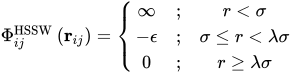
and the orientational component is given by (Eq. 3)

where is the solid angle of a patch () whose axis is (see Fig. 1 of Ref. 1), forming a conical segment.


Two patches
The "two-patch" Kern and Frenkel model has been extensively studied by Giacometti et al. [2].
Four patches
References
- ↑ Norbert Kern and Daan Frenkel "Fluid–fluid coexistence in colloidal systems with short-ranged strongly directional attraction", Journal of Chemical Physics 118, 9882 (2003)
- ↑ Achille Giacometti, Fred Lado, Julio Largo, Giorgio Pastore, and Francesco Sciortino "Effects of patch size and number within a simple model of patchy colloids", Journal of Chemical Physics 132, 174110 (2010)