Strongly correlating liquids
Strongly correlating liquids are defined as those for whom where (Eq. 6 [1])

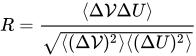
where represents fluctuations of the potential in the NVT ensemble and is the virial (see also Virial pressure).


Isomorphs[edit]
Lennard-Jones liquid[edit]
The liquid phase formed by the Lennard-Jones model is an example of a strongly correlating liquid[3].
References[edit]
- ↑ Nicholas P. Bailey, Ulf R. Pedersen, Nicoletta Gnan, Thomas B. Schrøder, and Jeppe C. Dyre "Pressure-energy correlations in liquids. I. Results from computer simulations", Journal of Chemical Physics 129 184507 (2008)
- ↑ Nicoletta Gnan, Thomas B. Schrøder, Ulf R. Pedersen, Nicholas P. Bailey, and Jeppe C. Dyre "Pressure-energy correlations in liquids. IV. “Isomorphs” in liquid phase diagrams", Journal of Chemical Physics 131 234504 (2009)
- ↑ Thomas B. Schrøder, Nicoletta Gnan, Ulf R. Pedersen, Nicholas P. Bailey, and Jeppe C. Dyre "Pressure-energy correlations in liquids. V. Isomorphs in generalized Lennard-Jones systems", Journal of Chemical Physics 134 164505 (2011)
- Related reading
- Nicholas P. Bailey, Ulf R. Pedersen, Nicoletta Gnan, Thomas B. Schrøder, and Jeppe C. Dyre "Pressure-energy correlations in liquids. II. Analysis and consequences", Journal of Chemical Physics 129 184508 (2008)
- Thomas B. Schrøder, Nicholas P. Bailey, Ulf R. Pedersen, Nicoletta Gnan, and Jeppe C. Dyre "Pressure-energy correlations in liquids. III. Statistical mechanics and thermodynamics of liquids with hidden scale invariance", Journal of Chemical Physics 131 234503 (2009)
- Trond S. Ingebrigtsen, Lasse Bøhling, Thomas B. Schrøder, and Jeppe C. Dyre "Communication: Thermodynamics of condensed matter with strong pressure-energy correlations", Journal of Chemical Physics 136 061102 (2012)