The printable version is no longer supported and may have rendering errors. Please update your browser bookmarks and please use the default browser print function instead.
- This article is about integral equations. For other the simulation method, see Replica-exchange simulated tempering or Replica-exchange molecular dynamics.
The Helmholtz energy function of fluid in a matrix of configuration
 in the Canonical ensemble is given by:
![{\displaystyle -\beta A_{1}({\mathbf {q} }^{N_{0}})=\log Z_{1}({\mathbf {q} }^{N_{0}})=\log \left({\frac {1}{N_{1}!}}\int \exp[-\beta (H_{11}({\mathbf {r} }^{N_{1}})+H_{10}({\mathbf {r} }^{N_{1}},{\mathbf {q} }^{N_{0}}))]~d\{{\mathbf {r} }\}^{N_{1}}\right)}](https://wikimedia.org/api/rest_v1/media/math/render/svg/6f788bb8c171a0c754e3aec088d3c269ff7bed6c)
where  is the fluid partition function, and
  ,
,  and
and  are the pieces of the Hamiltonian corresponding to the fluid-fluid, fluid-matrix and matrix-matrix interactions. Assuming that the matrix is a configuration of a given fluid, with interaction hamiltonian , we can average over matrix configurations to obtain
![{\displaystyle -\beta {\overline {A}}_{1}={\frac {1}{N_{0}!Z_{0}}}\int \exp[-\beta _{0}H_{00}(q^{N_{0}})]~\log Z_{1}(q^{N_{0}})~d\{q\}^{N_{0}}}](https://wikimedia.org/api/rest_v1/media/math/render/svg/2e92efa81f2a0f6b3f035909dd33eee00c792e0e)
(see Refs. 1 and 2)
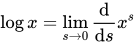
- An important mathematical trick to get rid of the logarithm inside of the integral is to use the mathematical identity
 .
.
One can apply this trick to the  we want to average, and replace the resulting power
  by
by  copies of the expression for
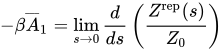
  (replicas). The result is equivalent to evaluate
  as
as
 ,
,
where  is the partition function of a mixture with Hamiltonian

This Hamiltonian describes a completely equilibrated system of  components; the matrix the identical non-interacting replicas of the fluid. Since
 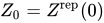 , then
![{\displaystyle \lim _{s\to 0}{\frac {d}{ds}}[-\beta A^{\rm {rep}}(s)]=\lim _{s\to 0}{\frac {d}{ds}}\log Z^{\rm {rep}}(s)=\lim _{s\to 0}{\frac {{\frac {d}{ds}}Z^{\rm {rep}}(s)}{Z^{\rm {rep}}(s)}}=\lim _{s\to 0}{\frac {{\frac {d}{ds}}Z^{\rm {rep}}(s)}{Z_{0}}}=-\beta {\overline {A}}_{1}.}](https://wikimedia.org/api/rest_v1/media/math/render/svg/8a4f920fddc4b941e5f629253d31ca8022c79f1d)
Thus the relation between the Helmholtz energy function of the non-equilibrium partially frozen system and the replicated (equilibrium) system is given by
![{\displaystyle -\beta {\overline {A}}_{1}=\lim _{s\rightarrow 0}{\frac {\rm {d}}{{\rm {d}}s}}[-\beta A^{\rm {rep}}(s)]}](https://wikimedia.org/api/rest_v1/media/math/render/svg/7654516da01b5e9fd609dc75dfbfd4ece3a3d3c6) .
.
Interesting reading
- Viktor Dotsenko "Introduction to the Replica Theory of Disordered Statistical Systems", Collection Alea-Saclay: Monographs and Texts in Statistical Physics, Cambridge University Press (2000)
References
- S F Edwards and P W Anderson "Theory of spin glasses",Journal of Physics F: Metal Physics 5 pp. 965-974 (1975)
- S F Edwards and R C Jones "The eigenvalue spectrum of a large symmetric random matrix", Journal of Physics A: Mathematical and General 9 pp. 1595-1603 (1976)